Now that the Spring school semester has finally concluded, I have a lot more time to spend at my favorite place: the Baytown Nature Center! It was a beautiful clear evening, humid but with a strong breeze in most places. The first animal to greet us on this visit was, quite surprisingly, a raccoon! She had been standing at the water's edge, and quickly approached the nearby trash can.
We had pulled over in front of the trash can after she had gone inside, and she wouldn't come out while we were there, just staring at us like this. After a few minutes, we went on our way so we wouldn't disturb her too much. This is one of the few times I've seen a raccoon out in broad daylight around here.
Just down the road, we saw a fight breaking out in a flock of Black Vultures standing around the road. The two or three that had been fighting flew away, but the rest of the flock (15 in total) stayed at the roadside, barely moving aside as our car pulled up.
Note the Red-Winged Black Bird on the other side of the roof!
My brother Travis discovered that several of them were eating something in the nearby ditch. He went out to find that it was - interestingly enough - another raccoon! This one not doing so well as the one in the trash can.
Red-Winged Blackbirds were, as usual, out in abundance, the males advertising themselves with prominent perches and mechanical songs.
A slightly more rare sighting was a White Pelican, sitting pretty on the shore overlooking Burnet Bay.
They're very big birds, a startling sight when I don't normally see them sitting here like this. They're somewhat common here in the Winter, but as Summer marches forth most of them migrate further north.
Yellow-Crowned Night Heron
This tropical plant, with it's absurdly bright pink flowers, always entertains me somehow. I just found out now it's called a Powder Puff Tree, one of the Calliandra species. Examining one of the flowers, I noticed something really interesting: there were several small blue-gray inch worms on it.
Closer examination led me to see that they were on several other flowers as well, clearly enjoying this plant. I have to wonder what butterfly or moth they turn out to be! I'll have to try and find out sometime.
Travis picked one up to get a closer look.
Herons were, as usual for the summer, very numerous. We saw eight different species today, all the usual residents: tri-colors, black and yellow crowns, great egrets and blues, snowys and cattles. You can spot this Little Blue Heron out on the rocks, overlooking turbulent Scott Bay.
There were a lot of Great Egrets out today.
Another species that was extremely numerous was the White Ibis: I saw over a hundred individuals during our hour-long visit. There's some sort of roosting area or rookery nearby, resulting in many, many ibis visiting the nature center and flying out to Scott Bay. They'll often fly right over your head, which is fantastic.
One of the many White Ibis flocks heading over to Scott Bay.
A few White Ibis foraging in the marshes.
Travis insisted that I take a picture of this giant block of foam. Sadly, there's always plenty of trash washed up on almost every shoreline here. All sorts of detritus, big and small. Kooky inventors like my brother love to trawl the wreckage for odd treasures.
On the drive in, I had seen this Forster's Tern hovering above one of the bay inlets. On the drive back out, he was still there, so I stopped for pictures.
Terns hunt by diving headfirst into the water, and this one seemed to have found a great spot with wind that allowed him to essentially hover in place. After only a minute, he dived and caught a small fish right in front of us! There were many terns here today, as we're getting into tern season: they hang out here in the summer. I saw Forster's mostly, but also a small flock of Gull-Billed Terns (four or five species are seen here with some frequency).
Sunset over Crystal Bay
To my surprise, the White Pelican from an hour ago was still there when we were driving out.
He was watching the sunset, I guess.
And just on the other side of the road: one of the many Yellow-Crowned Night Herons, with a full and beautiful breeding season crest.
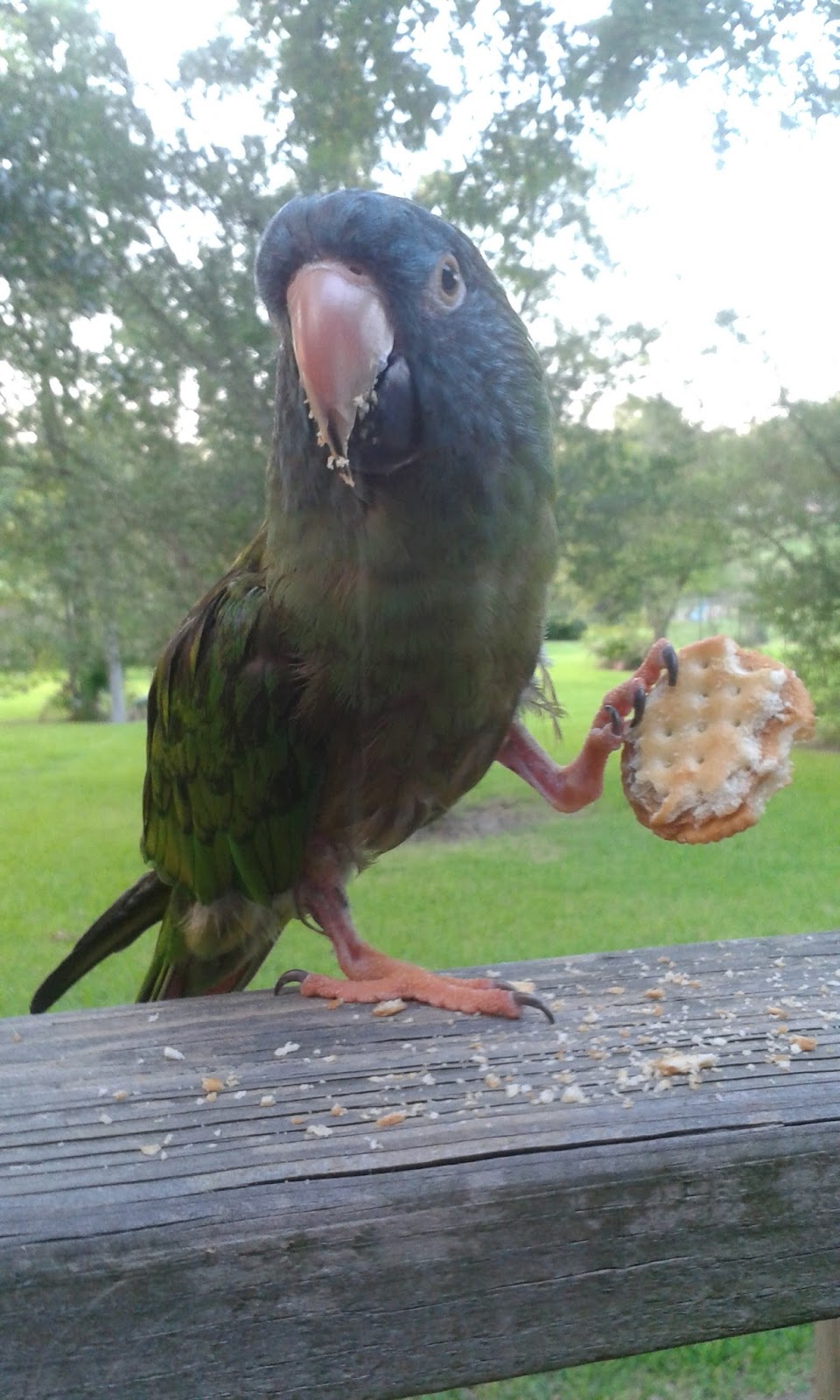
Much like a small child, my delightful and demanding Blue-crowned Conure loves to be taken on little outings to her closest playground, so she can climb and scream and destroy things to her heart's content. In my bird's case, this playground is the crepe myrtle tree in our garden. It's parrot safe (trees, though they may seem peaceful, can really be dastardly villains), and it's close to the house, so pretty safe for her and pretty convenient for the human who has to watch over her. Because, of course, she can't be left unsupervised. She'll start screaming her distress call the moment she's left alone anyway. We tried to take her on a walk once, thinking she might enjoy seeing some sights, and had to turn back because she was terrified of the mail boxes. If you have a small child, I hope she's slightly less fearful.
"Play it safe" is her bird way.
Other things that are very scary and alarming and have to either be attacked or fled from: the UPS truck; any unusual sort of car, like maybe just a color she hasn't seen before, especially scary if it decides to park across the street from us; unfamiliar cats; bowls from the cabinet; the pen attached to the fridge for writing on the grocery list; boxes that were not present in a room the day before; nail polish; bandages; any bird over a certain size flying over a certain height in the sky; plastic bags of any sort, but especially the big black trash bags.
Things she finds lovely and enjoyable, but are actually more dangerous than the cardboard box on the counter: dogs, the bigger and the barkier, the better.
Given the list (ever-growing) of strange things that terrify her - and hey, parrots are prey animals, I can't blame her - watching her on the "playground" is not just about watching out for predatory birds that might take her as a snack, or making sure she doesn't get caught by a gust of wind and fly off: it's also watching for the UPS truck. Or anything else that might set off an instantaneous panic attack.
You also have to keep up some verbal feedback. "Yip?" "Yip." "Ruff?" "Ruff." She wants to know you're paying attention, and engaged in this super-fun tree climbing time. You also have to look at her every now and then. Don't look at her for too long, and she'll think you're not paying attention, in which case she'll start making distress calls. You'll also be surprised at how quickly she can climb through the tangled branches, and just how invisible she becomes in the green foliage. If something happens, you need to know where she is anyway.
(and yes, my poor birdie plucks her feathers, which is why she's so bare in places; we're still trying strategies to solve the problem.)
There's also the odd "bird stuck in a tree" phenomena, where she climbs too high, doesn't understand the concept of climbing down, and proceeds to freak out because she's "stuck". If she does climb too high, preparations have to be made to get her down, including extra long sticks and possible assistance from other family members. We had to lure her down with a pop tart once, but we won't talk about that. (I think she's learned her lesson now and it's thankfully been years since we had to use that trick. If only she'd learn now that the bowls for my cereal are not deadly at all).
So, birdie playground time basically requires someone to stand and crane their neck up at a tree for up to an hour, armed with an arsenal of retrieval sticks. Meanwhile the bird has the time of her life, tearing off leaves, clambering around, sunbathing, chewing sticks, hanging from branches, looking at people or dogs in their yards across the street and saying "ruff" to them.
This is cute for a while but pretty soon your neck starts to hurt and it's kinda boring. Trying to read isn't that great between having to look up all the time and being interrupted by persistent "ruffs". Any work that requires consistent concentration is kinda a no-go. The bird wants all of your consistent concentration. So looking for bugs and stuff is kinda the best option.
Such as this fine fellow. They're everywhere. They fly with a giant buzz from leaf to side of your house to wherever else they like to hang out. I don't know what they are, which is terrible. I wish the focus of this picture was better, but you can see this one's got its proboscis mouth thing stuck into the leaf!
I found another one, very close by.
And look who else I found, peeking out from beneath the weird sun face that came with the house? A Green Anole, blending well with the house.
My cats are frequent company during birdie playground time, and Mr. Kitteh always likes to sit like this.
This little orange ladybug was trying to hide from the camera on my hibiscus plant.
Now those are all things I found on a playground run back in November. What follows are some things I discovered on a slightly more exciting day in early January.
I'm not kidding when I say that these bugs are everywhere! They're a pretty reliable find. Now the ones from November did look slightly different, but the overall form is the same, so I don't know if these are different species or what: I'm still totally clueless, I don't know what they are, I'll find out someday. And yes, it's as big as it looks: an easy two inches long, three across with the width of its legs accounted for. When you see these flying through the air, you get out of the way.
Now, bored as I am looking after my cute bird in the tree, I pick up a curling dead oak leaf that had been sitting on my weird giant leafed tropical plant (I'm not a botanist). Lo and behold, look what rolled out of it, to my enormous surprise:
A much smaller one of these buggys, only about an inch or so long! I suppose it was hiding or napping inside the leaf, maybe.
I left the buggy alone, put the leaf back, and slowly, slowly, the little buggy crawled back, until eventually it had disappeared back into the leaf from whence it came. Such an exciting story!
Meanwhile, Merle's doing great:
Cedar Waxwing songbirds are still around, going "see see see see" as they browse the neighborhood. I also hear one of the neighborhood's Barred Owl's rising early, with those booming musical whoooos, always a delight. The usual gang of Blue Jays is hanging out, and some sort of chickadee or titmouse is making a fuss over something. I'm busy examining what's happening on a branch of my hibiscus plant.
One of the flowers is withering. This wingless wasp, which does look very much like a large ant, investigates the blossom. I have a healthy respect for these fellows after one of them somehow managed to get on my face while I was in a car and stung me right next to my eye. It hurts, and I would recommend avoiding the experience.
A quick glimpse to the underside of the plant reveals a huge number of what I would guess to be aphids, accompanied by a ladybug (same color as the flower), and multiple wingless wasps, all of which I hope are feasting on these little beasts, since I would guess they're responsible for the flower's wilt. It's quite the congregation, and I was excited to have discovered them all! This is the first time I've witnessed such an infestation on one of these flowers. The hibiscus plant, in this current month of April, is blooming insanely wonderfully with about twelve flowers, none of which seem aphid affected at all.
Don't mess with these guys.
Another event of the day was that the holly plant had its little flowers, and the bees were going crazy over them. Berries were out in full, too.
This plant is mainly notable only because the bees like its flowers, various birds like to hide in it (Mockingbirds especially), and lizards clamber through it. My bird wants to clamber through it too, but the leaves have sharp points and it's probably not parrot safe, so her access is denied.
That's all I've got: some bugs, some birds. It's an exciting world out there, and I'm not often bored.
Consider this my photo album for our Spring Break family trip to enjoy the desert scenery of El Paso, TX. As of this writing, we still have a few more hours of adventure left here before heading back home.
As it stands now, I've seen three new bird species here in El Paso: Crissal Thrasher, Bufflehead duck, and Ladder-backed Woodpecker, which makes for a somewhat unlikely but definitely charming trio! One of El Paso's most common birds is the White-winged Dove: they're all over the parking lots, city parks, and gardens. Great-tailed Grackles are here too, just like in Houston, but I notice that the calls they make sound pretty different from those of Houston Great-tails. Very exciting!
Weather has been clear and sunny the whole trip, with lows of 50 F overnight, raising through the morning to the 60s and 70s, reaching 80 at the peak hours of the afternoon. Usually there's a cool breeze, which is a definite help when it gets into the hottest part of the day.
I'll be going through photos in rough order of day and relative location, so stay tuned for the photographic tour.
So, once upon a time, in a funky little art class, I made myself a gigantic styrofoam cat.
And when I say giant, I really do mean it, because here it is next to a regular cat and an average adult human's chair:
It's 4 foot, 3 inch tall cat!
I always decide to be a little ambitious. Most of the sculptures were not quite so tall (and they were still lovely!), but I've been doing this "art" thing for a while now, so I feel like I need to push the edges sometimes. Could I have made a much smaller cat? Yes. Would that have been a lot easier? Yes. Why did I want to make a cat sculpture that is larger than most children? Maybe to hear said children pointing it out with awe and wonder. That's definitely pretty rewarding.
Painting it took forever. That's what always happens with sculptures like this. The building is one thing, the painting is a whole 'nother ball game and usually takes twice as long and always takes more time and more effort than I think it will. You'd think I'd have learned that by now. It's the painting, not the building, that caused me to work overtime on this thing.
This thing was assembled from sheets of styrofoam, glue, and toothpicks. It's that easy. Some pliers to snip off the ends of the toothpicks, a little saw to cut and carve the styrofoam. The paint is just regular acrylics. It is worth noting that during the carving process styrofoam dust gets everywhere and requires a lot of vacuuming to clean up.
I don't really have a great place to put this thing. It's in my studio right now, keeping watch over my stuff, but that's not the most glorious place for it. And I don't know who would want a giant styrofoam cat, but this thing is totally for sale. So if you know anyone who wants a strange giant cat, hey, I've got one.
Just sayin'.
Anyway, here are some extra, unrelated photos!
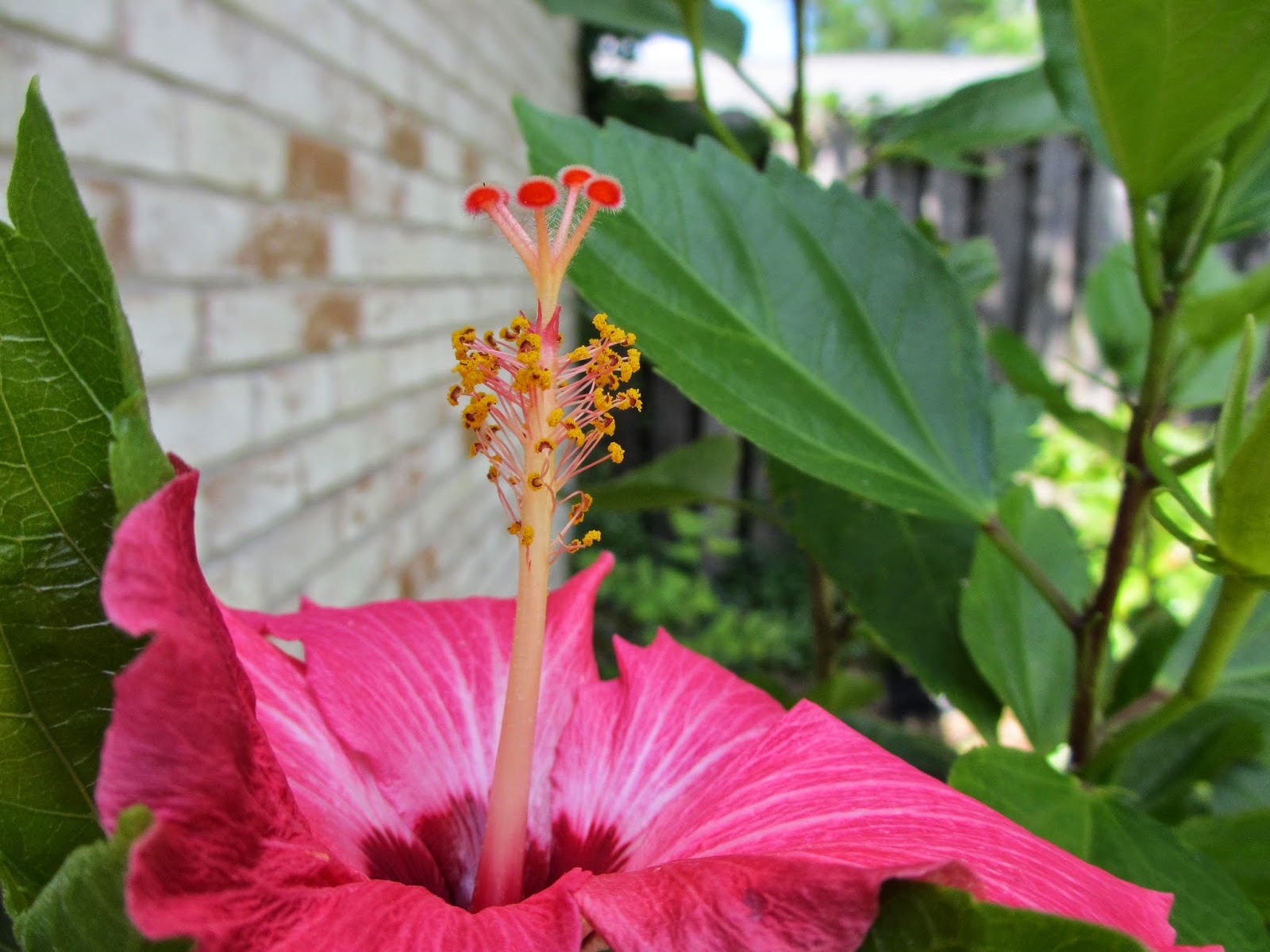
I don't know anything about plants, but these fuzzy antenna things going on with the hibiscus flowers are pretty dang cool.
A canoe trip through Sheldon Lake got us some close-up views of nesting water birds, such as this Little Blue Heron:
And these White Ibis:
There are hundreds of birds raising their young on little islands in this lake, and quite a variety of species: Cattle Egrets, Little Blue Herons, Yellow-crowned Night Herons, Black-crowned Night Herons, Tricolored Herons, White Ibis, White-faced Ibis, Roseate Spoonbills, Anhinga - these are all the species I was able to spot nesting in the trees. And they're all clustered together, little groups of White Ibis among little groups of Little Blues, the occasional night heron or White-faced Ibis here and there. Little Blues, White Ibis, and Cattle Egrets were most common. The herons had young at all stages of growth, from tiny fluffy nestlings to adult-sized juveniles, but the ibis children were all still small enough to stay hidden beneath their parents, and many of the ibis were still in the process of building their nests.
My photographer for this trip was my brother Travis. I was steering the boat and identifying the birds, so it was a team effort. Two sets of eyes are often better than one when it comes to spotting all the cool birds!
Not sure if this is a baby Cattle Egret or baby Little Blue, but it's adorable regardless.
The Little Blue and egret youngsters were loud and boisterous, many of the older ones walking around the branches and flapping their growing wings. Sometimes they'd get overexcited when a parent came in to feed them, squawking, pecking their siblings, even chasing down and almost tackling the parent. Some of the parents would keep their distance when they arrived back at the nest, as their multiple almost-grown youths run up to them. I saw parents trying to run away from their own children when they begged too aggressively for food.
Young herons are quite the handful, especially as they get older.
You can see here that there are three young Little Blues begging for food from a parent that - for the moment - is just sitting and waiting in the next tree over. The kids almost looked they were dancing as they bobbed their heads and flapped their wings, stretching up tall for their parent's attention.
The Yellow-crowned Night Herons I saw all had mostly grown up children. All the black-crowns I saw were still sitting tight on the nest, with no visible kids.
This was the first time I'd ever seen young Tricolored Herons! Unlike a lot of these heron kids,they've already got colors and patterns very similar to the adults.
Adult Cattle Egret.
Another very exciting thing to see was a family of Moorhens! I describe these birds as "duck chickens", or water chickens - they swim like ducks, look a bit like ducks, but their feet and beak looks more like a chicken's. This family - two adults and four tiny, fluffy chicks - were foraging among the reedy plants at the water line, in front of the trees the herons were nesting in.
They were all out in the open for a little while, but then they started to hide - luckily we got this picture before they hid completely! Look at their bald heads!
There were plenty of flowers, lily pads, dragonflies and butterflies around as well.
And, of course, there are alligators. A vital part of what's keeping this place safe for all those nesting birds. The gators might eat a few unlucky heron babies, but they'll keep all the egg-and-nestling munching predators away.
There were plenty of other birds around too, that may or may not have been nesting nearby, like blackbirds, seagulls, cormorants, and Great-tailed Grackles like this one:
They get all poofy when they make their crackly grackle noises.
It was great to see so many youngsters so close, and to observe such a variety of wildlife. I'll leave you with one last picture, of a lovely backyard snail: